Lake Tahoe is one of those landscapes that seems simple from a distance.
Water.
Mountains.
Sky.
But the longer I photograph it, the less simple it becomes.
The lake changes with the hour.
The mountains change with the atmosphere.
The shoreline changes depending on where you stand.
And light can transform the relationship between all three within minutes.
That is what keeps bringing me back photographically.
Not a single viewpoint.
Not a checklist of locations.
But the way water, mountain and light keep reorganizing the same landscape.
A Landscape Built Around Distance
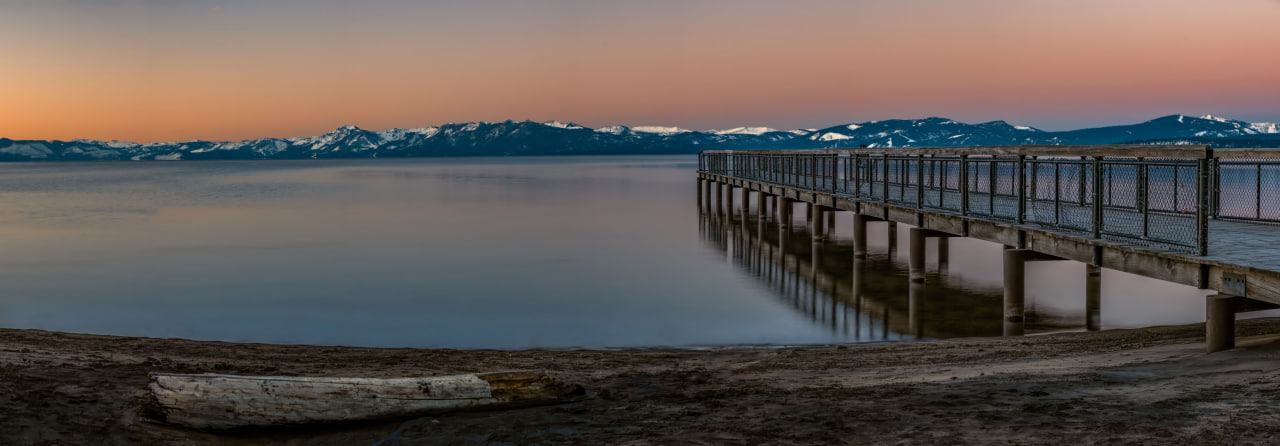
One of the first things I notice at Lake Tahoe is distance.
Even when the shoreline is close, the landscape rarely feels visually contained.
The water carries the eye outward.
The mountains establish another layer beyond it.
The sky extends the scene farther still.
This creates a natural sense of depth.
For a photographer, that depth can become the composition itself.
A foreground rock or shoreline may establish where the viewer stands.
The water creates the visual journey.
The mountains provide destination and scale.
The photograph begins to operate through layers rather than through a single subject.
That structure is one of Tahoe’s greatest strengths.
Water Is Never Just Foreground
It would be easy to treat the lake as the lower half of the photograph.
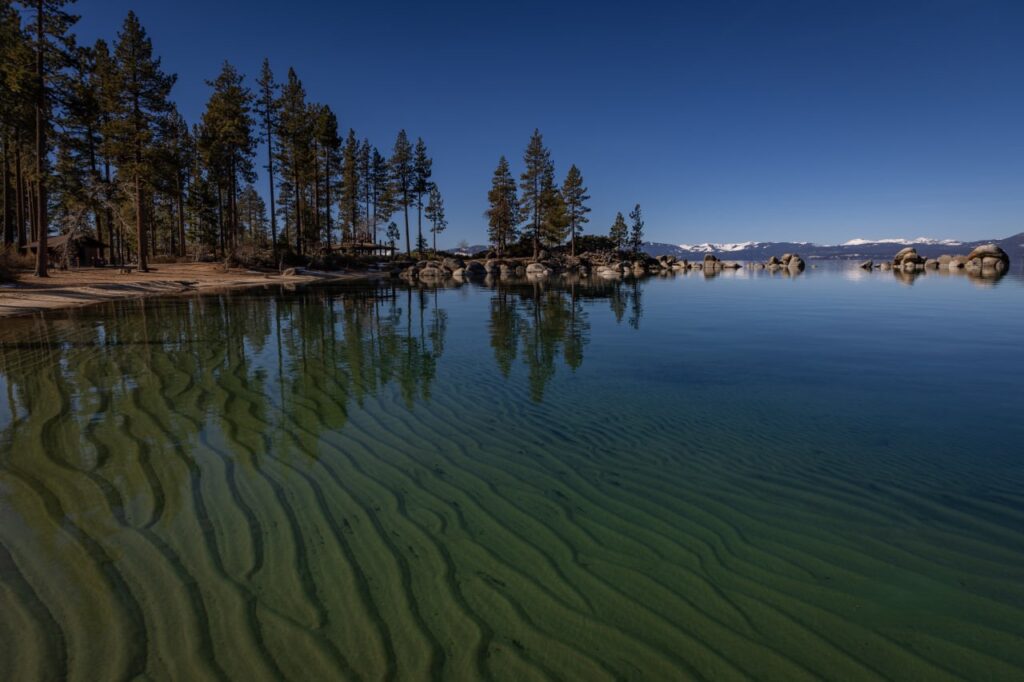
But water is more active than that.
It reflects.
It absorbs.
It changes color.
It records wind.
It can become glass-like in one moment and textured in another.
Sometimes the lake carries the sky so clearly that the boundary between atmosphere and reflection becomes difficult to separate.
At other times, waves break the surface into hundreds of small changes in light.
That means the same composition can feel completely different depending on the condition of the water.
Still water creates quiet.
Movement creates energy.
Reflection creates continuity.
And darker water can make the mountains and sky feel more luminous by comparison.
The Mountains Hold the Scene Together
The Sierra Nevada gives the lake its visual structure.
Even when the mountains are distant, they prevent the horizon from becoming anonymous.
They tell us where we are.
But photographically, I often find the mountains most interesting when they are not treated as isolated monuments.
Their relationship to the water matters more.
A peak reflected in calm water feels different from that same peak under heavy wind.
A distant range softened by haze feels different from one rendered with sharp winter clarity.
Clouds can make the mountains disappear almost completely.
Then, moments later, changing light can return them to the scene.
I am often photographing not simply mountains, but how strongly or softly they announce themselves.
Clarity Can Be Beautiful — and Difficult
Tahoe is famous for visual clarity.
That sounds ideal for photography.
Sometimes it is.
But perfect clarity is not automatically the most interesting condition.
When every detail is equally visible, a landscape can become visually descriptive without becoming emotionally expressive.
Atmosphere often gives the scene more depth.
Mist.
Haze.
Cloud shadow.
Snowfall.
Smoke-free atmospheric softness.
Light passing through moisture.
These conditions separate one layer from another.
A distant mountain becomes paler.
A shoreline recedes.
The photograph gains space.
For me, a little atmosphere can sometimes reveal more about the feeling of Tahoe than perfect visibility.
The Shoreline Changes the Experience
Lake Tahoe cannot be understood photographically from one edge.
Different shorelines create entirely different relationships with the water.
Some places feel open and expansive.
Others are framed by trees.
Some give the foreground to granite.
Others allow the lake to dominate almost completely.
This changes more than composition.
It changes the emotional quality of the photograph.
A wooded shoreline can create a sense of shelter before opening toward the lake.
An exposed shoreline can create immediate spaciousness.
Large rocks can give the image weight and physical presence.
A clean stretch of water can feel almost minimal.
The lake remains the same.
Our position changes what it becomes.
Why I Return to the Edges of the Day
Sunrise and sunset are obvious times for landscape photography, but not only because of color.
They change structure.
Early and late light creates separation.
A mountain may receive light while the water remains cool.
The sky may hold warmth after the land has moved into shadow.
Reflections become more visible.
Contrast softens.
And ordinary spatial relationships become more pronounced.
There is also a quieter rhythm at the edges of the day.
The landscape feels less occupied.
That matters to me.
I am not only looking for dramatic light.
I am looking for the point when the landscape feels settled enough that I can begin to notice its smaller relationships.
Weather Is Part of the Place
It is tempting to imagine an ideal version of Tahoe:
blue sky,
perfectly clear water,
snow on distant peaks,
no wind.
But the landscape becomes more interesting when weather is allowed into the story.
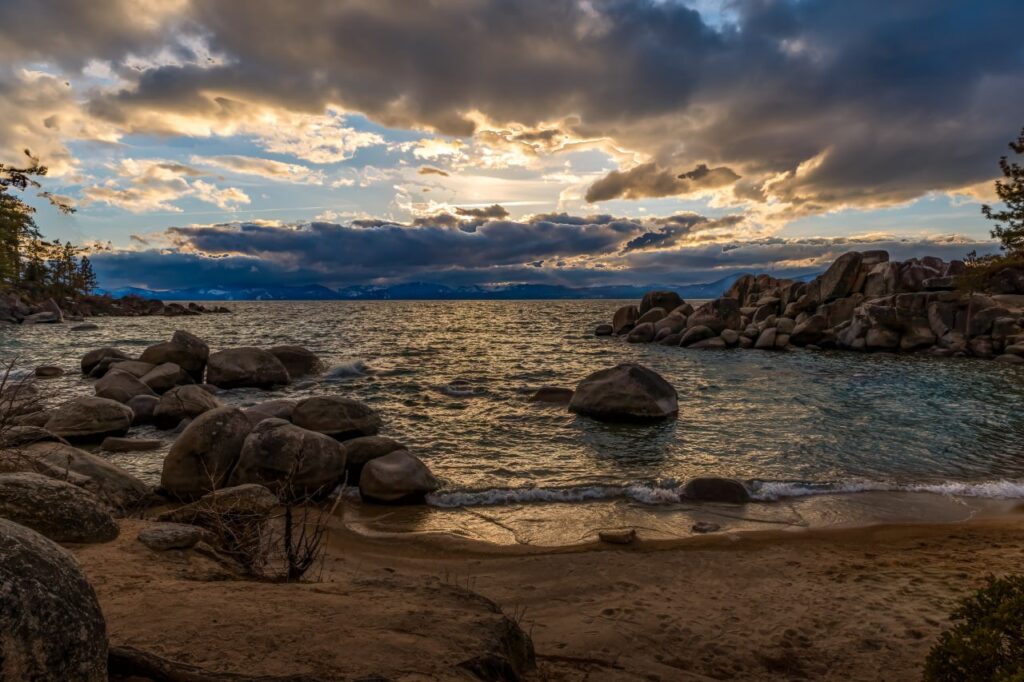
Clouds reduce visibility.
Wind changes the water.
Storm light can divide the lake into areas of brightness and darkness.
Snow simplifies everything.
Rain can remove color and leave only tone.
These are not failed conditions.
They are different versions of the place.
Photography becomes more interesting when I stop asking the landscape to match the photograph I imagined beforehand.
Instead, I ask:
What is this place giving me today?
From Place to Photograph
Every landscape photograph simplifies reality.
Tahoe is enormous.
A photograph is not.
The lake extends far beyond the frame.
The mountains continue beyond its edges.
Wind, temperature, sound and physical distance disappear completely.
So the photograph has to make choices.
What stays?
What becomes quiet?
Where does the eye begin?
Where should it travel?
Which relationship matters most?
For one photograph, it may be the reflection between mountain and water.
For another, the scale of an open horizon.
For another, a small patch of light moving across an otherwise dark landscape.
The goal is not to fit Tahoe into the frame.
It is to find one coherent experience within it.
A Place of Openness and Shelter
One reason Tahoe continues to interest me is that it can communicate seemingly opposite feelings.
The open lake creates spaciousness.
The mountains create enclosure.
Forest can create shelter.
The horizon creates release.
A single location can therefore feel both protected and expansive.
That tension is powerful.
It is also one of the reasons photographs from Tahoe can work in very different ways inside an interior.
One image may bring openness.
Another may bring stillness.
Another may feel grounded and protective.
The place does not have one emotional language.
It has several.
Photographing a Place, Not Collecting Views
When I return to a landscape repeatedly, the goal changes.
At first, I may be looking for photographs.
Eventually, I begin looking for relationships.
How does this shoreline behave in different weather?
Where does the first light arrive?
What happens when the mountains disappear into atmosphere?
When does the water become quiet enough to reflect?
What remains after sunset?
That is when photographing a location begins to feel less like collecting views and more like understanding a place.
Lake Tahoe continues to give me that experience.
The geography may be familiar.
The photograph rarely is.
The more familiar a landscape becomes, the less I photograph what it is — and the more I begin to photograph how it feels.