Grand Teton National Park photography begins with something difficult to ignore: the extraordinary presence of the mountains.
The Teton Range rises sharply above the valley of Jackson Hole, creating a skyline that feels almost impossibly direct.
There is little visual preparation.
The mountains do not gradually emerge through a long series of foothills.
They rise.
Their rugged peaks establish an immediate sense of scale, while the broad valley below gives the eye enough distance to understand something of their height.
But what interests me most about Grand Teton National Park is not only the drama of the mountains.
It is how that drama changes when it meets water, atmosphere, open space and silence.
The landscape can feel monumental from one viewpoint and surprisingly intimate from another.
A photograph can emphasize the ruggedness of the peaks or the stillness of their reflection.
The same mountain range can appear powerful, distant, mysterious or calm.
That is what makes the Tetons so photographically compelling: the mountains remain, but their emotional presence continues to change.
A Mountain Range Without a Gentle Introduction
Some mountain landscapes reveal themselves gradually.
The terrain rises through hills.
Then foothills.
Then increasingly distant ridges.
The viewer moves visually toward the highest peaks.
The Tetons behave differently.
Their eastern face rises dramatically from the valley, with no conventional foothill sequence softening the transition.
This unusual geography is connected to the Teton fault, where geological movement uplifted the mountain range relative to Jackson Hole.
The National Park Service notes that the range rises more than 7,000 feet above the valley.
Photographically, the effect is remarkable.
The mountains can occupy the skyline with an almost architectural authority.
Their forms are direct.
Their edges are strong.
Their scale is immediately apparent.
But a composition still needs more than a dramatic subject.
It needs a way for the viewer to understand that subject.
This is where the valley becomes essential.
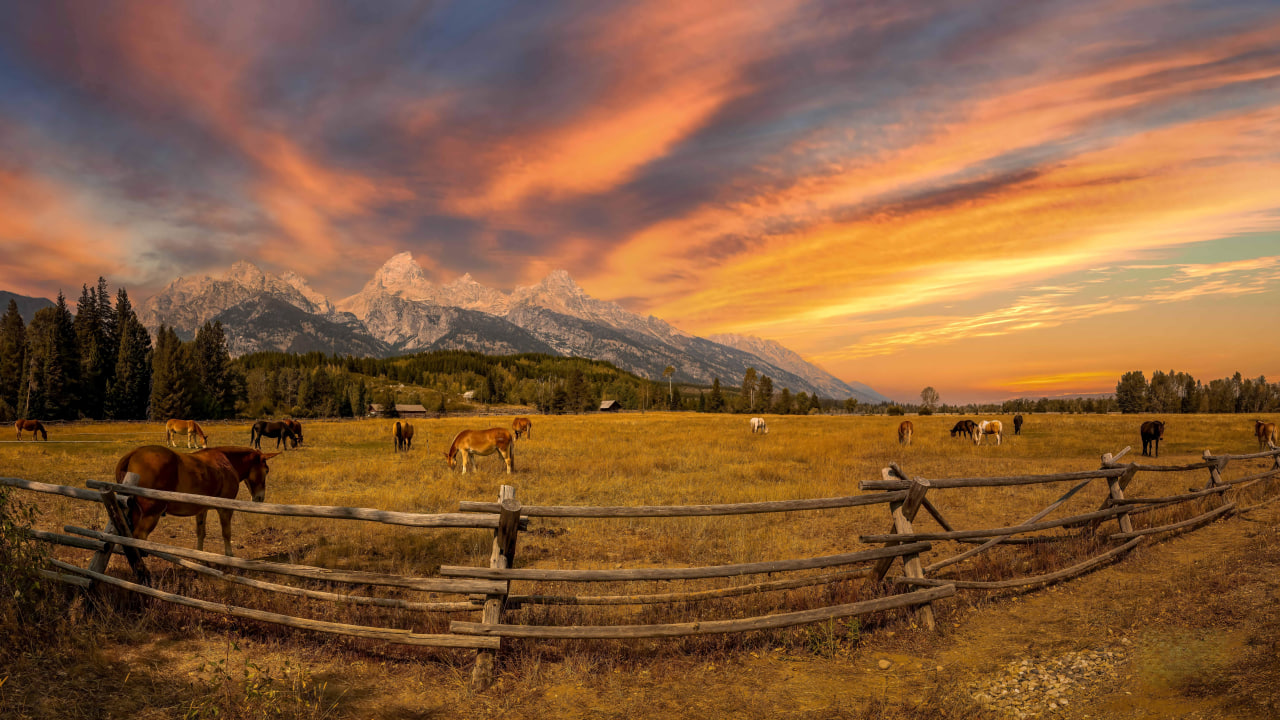
The open ground below the peaks gives them context.
Meadows, rivers, trees and distant vegetation establish reference points.
They show us not only how large the mountains are, but how much space exists between us and them.
Without that relationship, even an enormous mountain can become simply a shape within the frame.
Scale becomes meaningful when the photograph gives us something to measure it against.
The Valley Is Part of the Mountain
It is tempting to photograph Grand Teton National Park as though the mountains were the entire story.
They are certainly the most recognizable feature.
But the valley below them is equally important to the visual experience.
Jackson Hole creates the openness that makes the mountain range feel so commanding.
From many viewpoints, the eye travels across broad stretches of land before reaching the peaks.
That journey gives the photograph depth.
The valley establishes the foreground.
The middle distance carries the eye forward.
The mountain range becomes the visual destination.
The result is a composition that operates through relationships rather than a single dramatic object.
I find that especially important when photographing mountains.
A peak alone can communicate shape.
A peak within a landscape can communicate presence.
The difference lies in what surrounds it.
A stand of trees may emphasize distance.
A river may provide direction.
An open meadow may create breathing room.
A quiet foreground can allow the mountains to remain powerful without overwhelming the composition.
The space below the peaks is not empty.
It is what gives the peaks their scale.
Water Changes the Language of the Mountains
One of the most fascinating qualities of Grand Teton National Park is the relationship between mountains and water.
The park contains alpine lakes, mountain streams, and the winding Snake River.
These elements introduce something that the rugged peaks alone cannot provide.
Reflection.
Movement.
Softness.
Continuity.
The mountains are solid and enduring.
Water is responsive.
Its surface changes with wind, light and weather.
Sometimes it reflects the landscape clearly.
Sometimes it breaks the mountain forms into fragments.
Sometimes it carries the color of the sky more strongly than the reflection of the peaks.
This creates an extraordinary visual contrast.
The same rugged mountain range can become part of a composition that feels gentle and contemplative.
For me, water does not simply make the mountains more beautiful.
It changes their emotional character.
A mountain reflected in still water feels different from a mountain rising above a moving river.
One may communicate balance.
The other may communicate energy and passage.
Both are expressions of the same place.
Reflection Creates Another Kind of Space
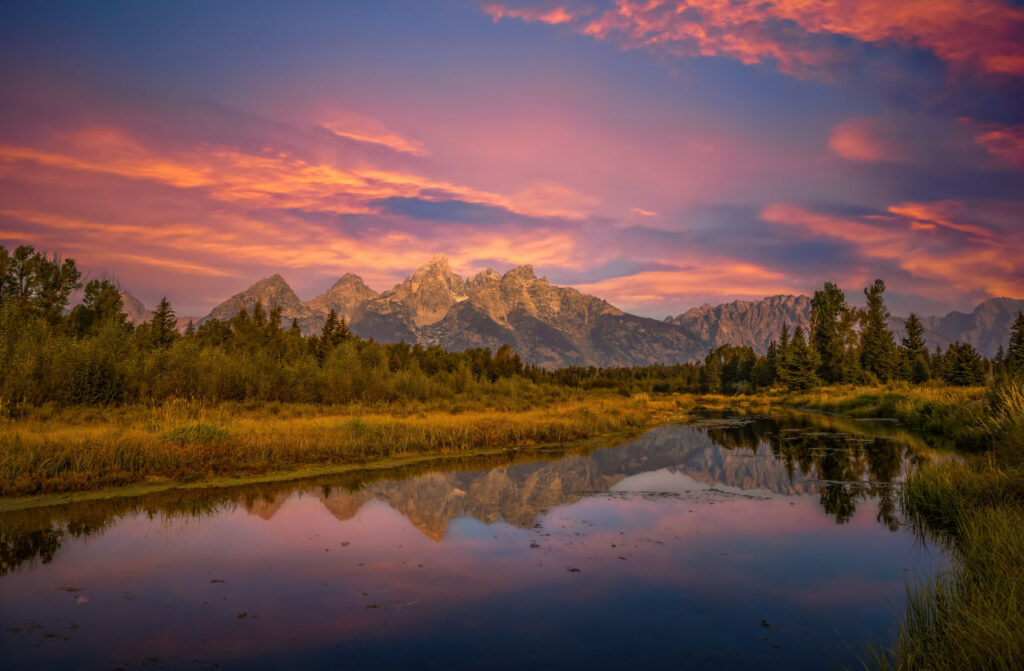
Reflection introduces a visual direction that would otherwise be absent.
Without it, the eye travels from the foreground toward the mountains and then upward into the sky.
With reflection, the landscape extends downward as well.
The photograph begins to contain two versions of the same world.
One above the water.
One within it.
That relationship can make a composition feel more complete.
At locations such as Schwabacher Landing, calm water can reflect the Teton Range with remarkable clarity.
But reflection is not interesting only because it reproduces the mountain forms.
Its greater value lies in how it changes our perception of the scene.
The enormous peaks become part of something quieter.
Their strong outlines find a softer counterpart.
The landscape begins to feel balanced between weight and delicacy.
This is one of the reasons I am drawn to reflected mountain landscapes.
Reflection allows an image to communicate strength without losing softness.
There can be drama in the mountains and stillness in the same photograph.
And neither quality needs to overpower the other.
The Snake River Gives the Landscape Direction
A lake can create a sense of pause.
A river introduces movement.
The Snake River winds through Jackson Hole, changing the visual relationship between the valley and mountains.
Its bends can create natural leading lines.
Its banks introduce texture and rhythm.
Its surface responds to the changing sky.
And its course gives a photograph a sense of direction.
The river becomes a visual journey.
The viewer’s eye can follow it through the foreground and into the distance.
The mountains provide the destination.
This relationship between moving water and stationary peaks gives the landscape another kind of presence.
It reminds us that the scenery is not static.
The mountains may seem permanent from our human perspective, but the valley is part of a living, changing environment.
Water continues to move.
Channels shift.
Vegetation changes with the seasons.
Light reorganizes the scene.
A photograph stops one moment within that continuous process.
For me, this is one of the deeper attractions of landscape photography.
The subject may appear timeless.
But the image belongs to a particular moment.
The Difference Between Seeing and Feeling Scale
Photography reduces an enormous landscape to a rectangle.
A mountain that towers thousands of feet above the valley may appear only a few inches high on a screen.
The physical experience disappears.
We no longer feel the distance.
We no longer need to raise our heads toward the peaks.
We cannot experience the full width of the skyline beyond the edges of the frame.
The photographer must find another way to communicate scale.
Composition becomes essential.
A small tree may establish proportion.
A broad foreground may preserve distance.
A river may carry the eye through several layers of the scene.
Atmospheric perspective may separate the near landscape from the far mountains.
Each decision gives the viewer information about the space.
But scale is not only a technical question.
It is also emotional.
A photograph may show an enormous mountain and still feel surprisingly intimate.
Another may show only part of the range and communicate extraordinary openness.
The difference comes from how the image positions the viewer within the landscape.
Do we feel close?
Distant?
Surrounded?
Exposed?
Are we looking toward something?
Or do we feel as though we are already inside it?
Those questions matter to me more than simply fitting the entire mountain range into the frame.
Light Reveals the Character of the Peaks
Light is one of the most powerful ways the Teton Range changes throughout the day.
Under clear midday conditions, the mountains can appear sharply defined.
Rock faces, snowfields and ridgelines become descriptive.
The viewer sees structure.
During lower-angle light, the same peaks can feel entirely different.
A ridge may catch the sun while the valley remains in shadow.
One face of a mountain may become luminous while another disappears into darkness.
Clouds may reveal only part of the skyline.
The mountains stop functioning as a uniformly visible subject.
They begin to reveal themselves selectively.
I find this especially interesting photographically.
When everything is clearly visible, the eye may try to understand the entire mountain at once.
When light reveals only certain forms, the photograph gains hierarchy.
One ridge becomes important.
A peak separates from the clouds.
A distant slope becomes softer.
Light helps organize the landscape.
It gives the eye a path.
And sometimes it allows the mountains to feel more mysterious than they do under perfect visibility.
When Atmosphere Softens the Monumental
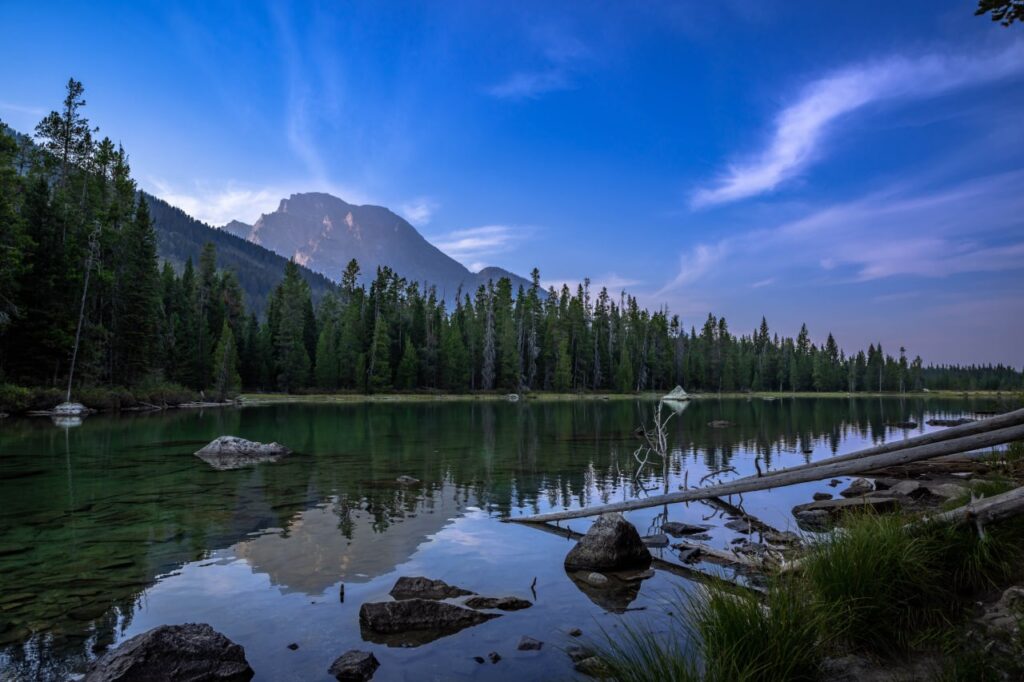
The Tetons are often photographed in exceptionally clear conditions.
And understandably so.
The mountain skyline is impressive.
But clarity is only one way to communicate the landscape.
Clouds, mist and atmospheric haze can create an entirely different experience.
A peak may disappear into low cloud.
A ridge may remain visible while the higher summits become concealed.
Soft light may reduce contrast between the mountains and the sky.
These conditions change our perception of distance.
The mountains become less immediately descriptive.
Their forms emerge gradually.
The viewer may sense more than can be clearly seen.
I find this kind of atmosphere particularly compelling because it introduces restraint into an otherwise dramatic landscape.
The mountains remain enormous.
But they no longer need to announce their full scale.
Part of the scene can remain hidden.
And that absence may create a stronger feeling than perfect visibility.
Sometimes atmosphere allows a landscape to communicate more by revealing less.
The Importance of Silence
Silence is difficult to photograph.
A camera records light, not sound.
Yet certain photographs seem to communicate quietness almost immediately.
Why?
For me, the feeling often comes from the relationship between visual elements.
A balanced composition.
A stable horizon.
A calm surface of water.
A restrained palette.
A foreground without excessive competition.
Light that does not demand constant attention.
These qualities can encourage the viewer to look more slowly.
And that slower experience can suggest something of the quietness we associate with being in nature.
Grand Teton National Park offers a particularly interesting contrast.
The mountains are visually powerful.
They can fill a composition with rugged edges and dramatic forms.
But the valley can be open and calm.
Water can become still.
Atmosphere can soften the skyline.
The photograph can contain enormous visual strength without feeling restless.
That balance is what interests me.
I do not need to make the mountains less powerful.
I want to find the moments when their power can be experienced quietly.
A Landscape That Changes With Position
A mountain does not look the same from every direction.
Its shape changes.
The relationship between peaks changes.
A summit that dominates one composition may become less prominent from another viewpoint.
The valley, water and vegetation also change the experience.
This is one reason Grand Teton National Park cannot be reduced to a single iconic photograph.
A lakeshore creates one relationship with the mountains.
A river overlook creates another.
A forest-framed view introduces a sense of shelter.
An open valley composition emphasizes distance and scale.
Each perspective reveals something different.
The subject remains recognizable.
But the photograph tells another story.
This is what makes exploring a familiar landscape photographically rewarding.
The goal is not simply to find another angle of the same famous view.
It is to discover how changing our position changes the experience of the place.
Photographing Beyond the Iconic View
Grand Teton National Park is one of the most recognizable mountain landscapes in the American West.
That recognition creates an interesting challenge.
The viewer may already know what the mountains look like.
A photograph that only confirms that expectation may be beautiful, but it may not offer much beyond recognition.
I believe there is another possibility.
Instead of asking how to photograph the familiar view, I can ask what relationship within that view has my attention.
Perhaps it is the contrast between the mountains and a quiet foreground.
Perhaps it is a reflection that creates unexpected balance.
Perhaps it is the shape of a river moving through the valley.
Perhaps it is the way cloud shadow divides the landscape.
The location does not need to become unrecognizable.
But the photograph should have a reason to exist beyond documenting the landmark.
For me, the most rewarding images are those that allow the place to feel familiar and newly discovered at the same time.
From the Landscape to the Photograph
Every landscape photograph is an act of selection.
The natural world does not arrive already framed.
The mountain range continues beyond the edges of the image.
The valley extends in directions the viewer cannot see.
The wind, temperature, sound and physical experience of the place remain outside the photograph.
What stays is the visual relationship the photographer chooses to preserve.
That makes restraint important.
Including more does not necessarily communicate more.
Sometimes a carefully chosen foreground, a section of the mountain range and a single reflection can hold the essential feeling of the place.
Other photographs may need the full breadth of the skyline.
There is no universal composition.
The decision depends on what the photograph is trying to communicate.
Scale.
Stillness.
Distance.
Shelter.
Atmosphere.
A moment of changing light.
The challenge is recognizing which quality matters most and allowing the other elements to support it.
What Grand Teton Teaches Me About Presence
The most compelling quality of Grand Teton National Park may be its ability to hold apparently opposite experiences together.
The mountains are immense.
The valley is open.
The rock faces are rugged.
The water can be still.
The skyline is unmistakable.
The atmosphere is constantly changing.
A photograph may feel dramatic and peaceful at the same time.
Strong and delicate.
Expansive and intimate.
This is what I want to preserve in my landscape photography.
Not simply the recognizable identity of a place.
But the relationship between its physical character and the feeling it creates.
In an interior, that distinction becomes important.
A photograph of the Tetons does not have to function as a declaration of wilderness or adventure.
It may bring stability through the presence of the mountains.
Openness through the valley.
Calm through the water.
Depth through atmosphere.
The landscape offers more than one emotional experience.
The photograph determines which of those experiences can continue beyond the place where it was made.
Scale, Reflection and Silence
Grand Teton National Park is not a quiet landscape because it lacks drama.
It is quiet in a more interesting way.
The mountains can be overwhelming.
The valley can be expansive.
The river can be full of movement.
The weather can change the scene in minutes.
Yet within all of that, there are moments when the elements seem to settle into a relationship that feels complete.
The mountains establish strength.
The foreground gives them context.
The water creates continuity.
The light reveals what matters.
And the atmosphere allows the viewer to experience the landscape without needing every detail at once.
That is the quality I keep looking for in mountain photography.
Not simply a beautiful view.
But a moment when scale becomes understandable, reflection introduces balance, and the entire composition begins to feel quiet.
The Tetons remind me that a landscape does not have to become smaller to feel intimate. Sometimes, the greatest sense of peace comes from standing before something immense.