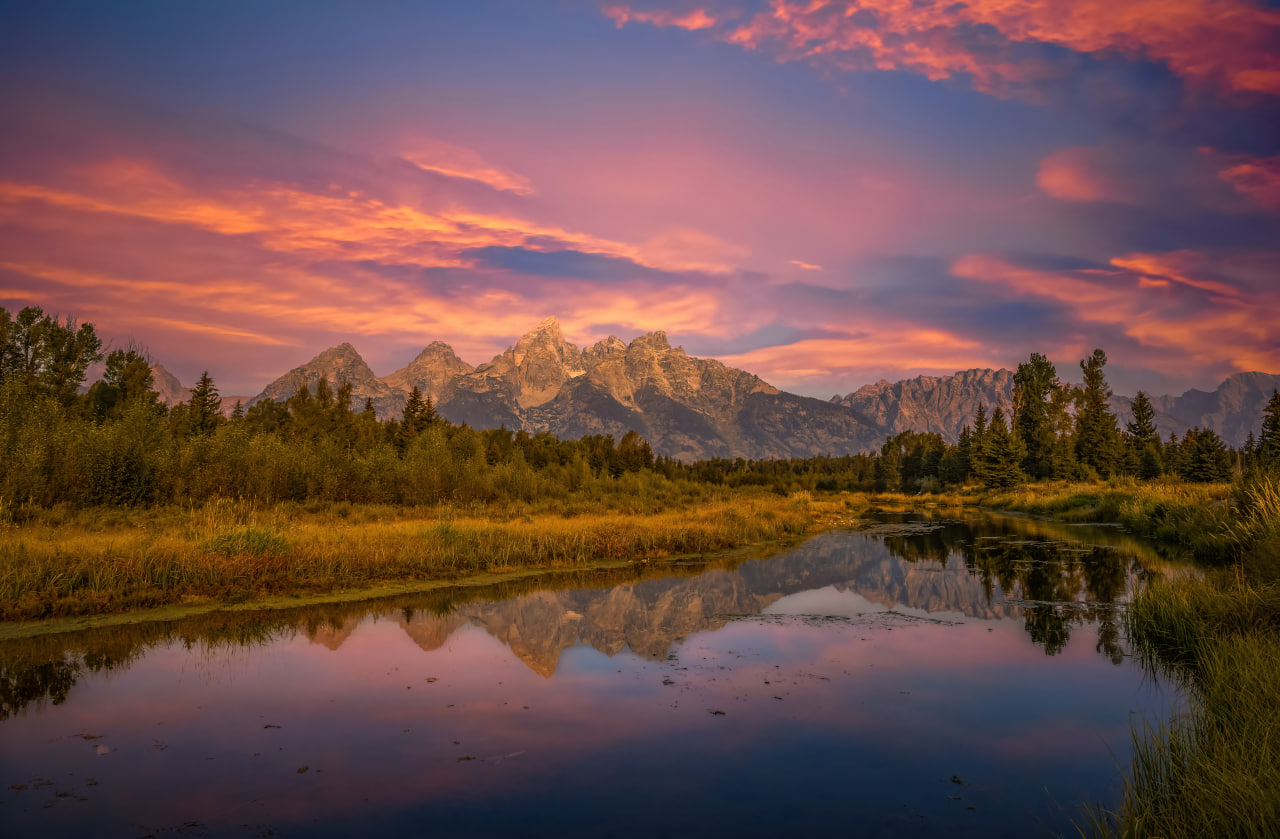
Schwabacher Landing photography is about more than capturing the dramatic peaks of Grand Teton National Park.
It is about discovering the quiet relationship between mountains, water, reflection and light.
Some landscapes impress us through their scale.
Others stay with us because of their stillness.
At Schwabacher Landing, those two qualities can exist within the same frame.
The mountains rise with extraordinary presence.
The water holds their reflection.
Trees and vegetation establish the foreground.
And between these elements, the landscape creates a balance that feels almost architectural.
What interests me most about this place is not simply the opportunity to photograph one of America’s most recognizable mountain ranges.
It is the relationship between something immense and something remarkably quiet.
The mountains establish the scale. The reflection changes how we experience it.
That relationship is at the heart of what makes Schwabacher Landing such a compelling photographic subject.
Where the Mountains Meet Their Reflection
The Teton Range has an unusually strong visual identity.
Its steep, rugged peaks rise dramatically above Jackson Hole, creating a mountain skyline that feels immediate and commanding.
At Schwabacher Landing, however, the experience is different from looking directly toward the mountains from an open overlook.
The water introduces another element.
It allows the mountains to appear twice.
Once as solid forms rising into the sky.
And again as reflected forms extending downward into the foreground.
This creates a composition with two directions.
The mountains pull the eye upward.
The reflection draws it back down.
The viewer moves between the actual landscape and its mirrored image.
That visual conversation gives the scene a particular kind of stillness.
It feels complete without needing to be symmetrical in every detail.
Reflection Is More Than a Mirror
It is easy to think of reflection as duplication.
A mountain appears above the water.
The same mountain appears below it.
But photographically, reflection does something much more interesting.
It changes the emotional structure of an image.
Without water, the Tetons can feel powerful, sharp and monumental.
Their rugged forms dominate the landscape.
With reflection, something changes.
The same mountains begin to feel more balanced.
The water introduces a second visual world.
The hard edges of the peaks become part of a softer composition.
The upper and lower halves of the image begin to communicate.
And the enormous physical scale of the landscape can suddenly feel more approachable.
For me, that is one of the most fascinating qualities of reflected landscapes.
The reflection does not diminish the power of the mountains. It gives that power somewhere quiet to rest.
The Importance of Still Water
A reflection depends on conditions that a photographer cannot fully control.
Even a small amount of wind can change the surface.
A clear mountain reflection may become a series of broken shapes.
The water may hold the color of the sky while losing the definition of the peaks.
The scene can change in seconds.
This is why patience matters so much when photographing reflected landscapes.
The strongest composition may already be in front of the camera.
The mountains may be beautifully illuminated.
The foreground may be perfectly arranged.
But the water may not yet be carrying the scene in the way I want.
Sometimes the right decision is not to change position.
It is to keep observing.
To notice how the surface responds.
To recognize whether the movement adds something meaningful or distracts from the larger relationship.
Perfectly still water is not always necessary for a successful photograph.
But when stillness is central to the image’s emotional purpose, the condition of the reflection becomes part of the composition itself.
Light Changes the Mountain Before It Changes the Photograph
Mountain landscapes are often associated with dramatic sunrise and sunset light.
The Tetons are especially compelling when low-angle light reveals the structure of the peaks.
But strong color alone does not guarantee a strong photograph.
What matters is how light organizes the scene.
Light may separate the mountains from the sky.
It may reveal snowfields and rock faces.
It may create a subtle difference between the actual peaks and their reflection.
And it may establish a visual hierarchy that was less apparent only moments earlier.
At Schwabacher Landing, the presence of water makes these changes especially interesting.
A change in the sky can influence the entire image.
Warm light above the mountains may reappear in the reflection.
Clouds can interrupt that continuity.
Shadows can give the foreground greater weight.
Sometimes the light creates drama.
Sometimes it simplifies the landscape.
I am particularly interested in the moments when the photograph feels balanced rather than merely spectacular.
When light supports the relationship between mountain, water and foreground without forcing one element to overpower the others.
The Foreground Gives the Mountains Their Distance
The Tetons are the obvious subject.
But a photograph of Schwabacher Landing is not made meaningful by the mountains alone.
The foreground plays an essential role.
Water, grasses, small trees and natural shoreline forms establish where the viewer stands.
They give the landscape a point of entry.
From there, the eye can move across the reflection toward the distant peaks.
This journey matters.
Without a strong relationship between foreground and background, an immense mountain range can become surprisingly flat in a photograph.
The mountains may still look impressive.
But the viewer may not feel the distance between here and there.
A carefully considered foreground restores that relationship.
It creates layers.
It gives scale.
And it allows the photograph to communicate more than the recognizable shape of the Teton Range.
The viewer begins to experience the landscape spatially.
Not simply as mountains in the distance, but as a place with depth and atmosphere.
Finding Order in a Complex Landscape
A place like Schwabacher Landing offers many photographic elements.
Mountains.
Clouds.
Trees.
Water.
Reflections.
Grasses.
Branches.
Changing light.
The challenge is deciding which relationships matter most.
A photograph can easily become crowded when every element is given equal importance.
A branch may interrupt the mountain skyline.
A bright patch of vegetation may compete with the reflection.
A foreground shape may draw attention away from the natural rhythm of the scene.
This is where I become especially attentive to composition.
I look for a clear structure.
Something that gives the eye a natural beginning.
A relationship between the large forms and the small ones.
Enough visual depth to preserve the sense of place.
And enough restraint that the image does not become a collection of unrelated details.
The goal is not to eliminate the complexity of nature.
It is to discover the order already present within it.
A photograph becomes quieter when its elements stop competing and begin belonging together.
The Moment Before Everything Changes
Landscape photography often involves working within moments that are temporary.
A reflection can disappear when the wind arrives.
A mountain can move into shadow.
A cloud can change the balance of the sky.
Light can become stronger, softer or less interesting within minutes.
That uncertainty is part of the experience.
It also changes how I think about timing.
There are moments when the temptation is to keep waiting for something more dramatic.
A brighter sky.
A stronger color.
A more spectacular reflection.
But the best photograph is not always the photograph with the greatest visual intensity.
Sometimes the image is already complete.
The mountains have enough presence.
The water is quiet.
The foreground holds the composition.
And the light gives every element its place.
Recognizing that balance is as important as recognizing a dramatic moment.
Photography asks us not only to respond to change.
It asks us to understand when enough has already happened.
Why Stillness Changes the Experience of Scale
Mountains often make us aware of our own physical smallness.
Their size is difficult to comprehend.
Their forms are permanent on a human timescale.
Their presence can feel overwhelming.
Yet when those mountains appear in calm water, the emotional experience changes.
The reflection introduces another kind of scale.
Something enormous is held within something delicate.
A rugged mountain range becomes part of a quiet surface.
The photograph contains strength and softness at the same time.
That contrast is powerful.
It reminds me that landscape photography does not have to choose between drama and calm.
The same image can communicate both.
The physical scale can remain extraordinary while the emotional atmosphere becomes gentle.
At Schwabacher Landing, this relationship is especially clear.
The mountains give the photograph its presence.
The water gives that presence a different voice.
What Remains Beyond the Photograph
A photograph records only a small part of the experience of being in a landscape.
It cannot reproduce the temperature of the morning air.
The sound of water moving gently through vegetation.
The feeling of standing beneath a mountain range that occupies so much of the horizon.
Or the continuous changes that happen before and after the shutter is released.
Those experiences exist outside the frame.
But they can still influence the decisions made within it.
What to include.
What to leave out.
Where to establish the horizon.
How much foreground to preserve.
Whether the reflection should dominate or simply support the composition.
These choices become a way of translating a physical experience into a visual one.
I do not expect a photograph to reproduce everything I experienced in a place.
I want it to preserve something essential about that experience.
A feeling.
A relationship.
A moment of visual clarity.
Something that remains meaningful after the light and weather have changed.
From Grand Teton to the Spaces We Inhabit
When a photograph like this moves into an interior, its physical context changes completely.
The mountain landscape is no longer enormous.
It exists within the dimensions of a print.
The water no longer moves.
The light no longer changes.
Yet the visual relationships remain.
The mountain peaks establish structure.
The reflection introduces balance.
The water creates a sense of calm.
The foreground gives the eye a place to begin.
Together, these qualities can bring a distinctive presence into a room.
In a quiet residential space, the photograph may feel contemplative.
In a hospitality suite, it may introduce both a connection to place and a sense of visual rest.
In a professional environment, the combination of open distance and stable mountain forms may offer a welcome contrast to the room’s more functional elements.
The photograph does not need to dominate the architecture.
Its value can come from the relationship it creates with the person experiencing it.
That is an important part of how I think about fine-art landscape photography.
The artwork should not only remind us of where it was made. It should bring something of that place into where we are.
The Balance Between Strength and Quiet
What makes Schwabacher Landing so memorable to me as a photographic subject is the coexistence of qualities that might initially seem opposite.
The mountains are dramatic.
The water can be gentle.
The rock faces are rugged.
The reflection is delicate.
The landscape has immense scale.
Yet the composition can feel intimate.
These contrasts do not compete.
They strengthen one another.
Without the mountains, the reflection would lose much of its significance.
Without the water, the mountains would communicate a different kind of presence.
Together, they create an experience that is neither purely dramatic nor purely peaceful.
It is balanced.
And that balance is what I want the photograph to hold.
When the Landscape Becomes Quiet Enough to See
There is a difference between recognizing a beautiful place and recognizing the photograph within it.
Schwabacher Landing is undeniably beautiful.
But beauty alone is not the complete story.
A photograph requires decisions.
It asks us to look beyond the obvious subject.
To notice the relationships between elements.
To understand what light is doing.
To pay attention to the foreground.
To recognize when the reflection becomes more than a mirror.
And sometimes to resist the temptation to make the image more dramatic than it needs to be.
The most meaningful landscape photographs are not always the ones that show us the greatest amount of nature.
Sometimes they are the ones that reveal the clearest relationship within it.
At Schwabacher Landing, that relationship is between mountain and water.
Between immense scale and quiet reflection.
Between what rises above the landscape and what is held gently beneath it.
The mountains give the landscape its strength. The reflection gives us time to feel it.