Some photographs begin with drama.
Others begin with waiting.
Tahoe Afterglow belongs to the second kind.
Lake Tahoe can be visually overwhelming. There is enormous scale, remarkable clarity, mountain structure, changing water and a sky capable of becoming the dominant subject within minutes.
The temptation is to photograph all of it.
But sometimes the strongest image appears when the landscape begins to simplify.
The sun moves lower.
Contrast softens.
Activity along the water becomes less important.
And the scene starts to feel less like a destination and more like a state of mind.
That quieter transition is what interested me here.
After Sunset Is Not the End
The moment the sun disappears is often treated as the conclusion of sunset.
For a photographer, it can be the beginning of something else.
Direct light is gone, but color remains in the atmosphere.
The mountains begin to lose detail.
The water becomes less descriptive and more reflective.
Colors that were separated during the brighter part of the evening begin to relate to one another.
That period can be brief.
And it asks for patience because there is no guarantee that the remaining light will develop into something meaningful.
Sometimes it fades.
Sometimes the sky becomes flat.
And sometimes the entire landscape seems to hold the last color for just a little longer.
That is the afterglow.
Water Changes the Light
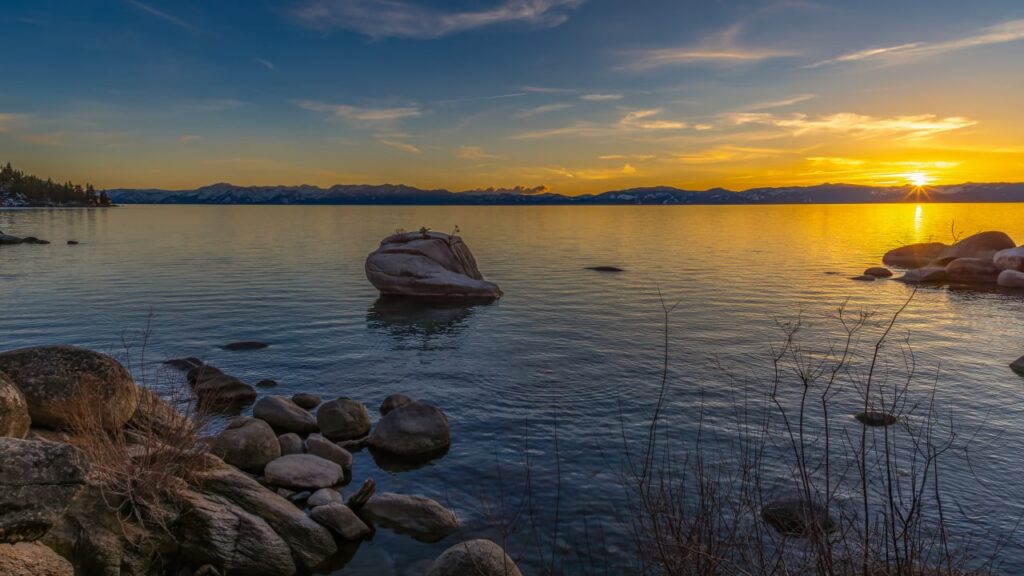
Water has always fascinated me photographically because it does more than occupy the foreground.
It receives the sky.
That relationship can transform an image.
A warm atmosphere above the mountains can become a second field of color on the lake.
The photograph is no longer divided simply into sky, mountain and water.
The elements begin to communicate.
Color travels downward.
The reflection introduces continuity.
The scene feels connected rather than assembled.
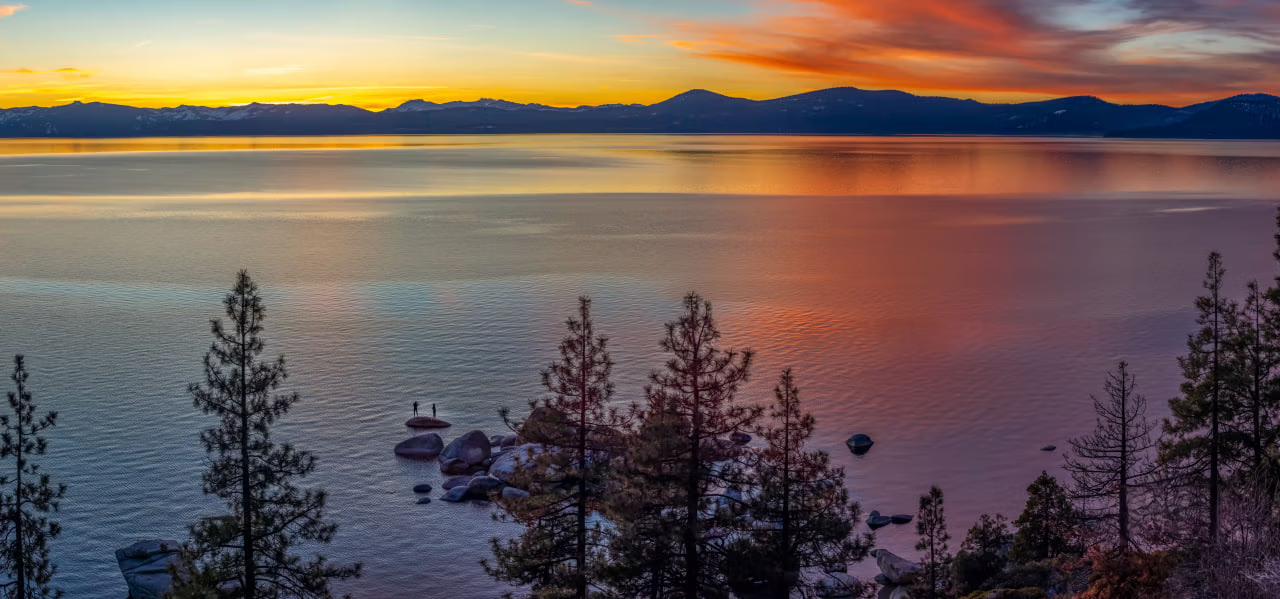
In Tahoe Afterglow, the water is important for exactly that reason.
It carries the remaining light into the lower part of the composition and gives the photograph much of its quietness.
The Mountains Do Not Need to Dominate
The Sierra Nevada gives Lake Tahoe much of its physical identity.
But a mountain does not always need to become the loudest element in a photograph.
Here, I wanted the mountains to establish distance and structure without overpowering the atmosphere.
They become a boundary between water and sky.
A darkening form.
Something solid against the changing light.
That restraint matters to me.
Landscape photography can easily become a search for maximum impact — the biggest mountain, strongest color, most dramatic cloud or brightest light.
But presence does not always come from intensity.
Sometimes it comes from allowing one element to become quieter so another can be felt.
Waiting for the Image to Settle
There is a particular point during evening light when I stop looking for what else might happen and begin paying attention to what is already there.
That change is important.
Photography becomes less about chasing the next moment and more about recognizing when the composition has reached its own balance.
The water.
The distant mountains.
The remaining color.
The space between them.
Nothing needs to announce itself.
The photograph begins to settle.
Those are often the scenes I remember longest.
Photographing Quiet Is Different From Photographing Emptiness
A quiet photograph still needs structure.
Without it, calm can become visually weak.
The eye needs somewhere to begin and somewhere to travel.
In a landscape like Tahoe, the layers naturally provide that path.
Water creates foreground and distance.
The mountains establish the horizon.
The sky opens above them.
The reflection connects the whole composition.
The photograph can therefore remain restrained without becoming empty.
That distinction is central to much of my work.
I am not looking for landscapes without information.
I am looking for landscapes where the information has found an order.
What the Photograph Feels Like to Me
I can describe location, light and composition.
But eventually every photograph becomes less about what was physically in front of the camera and more about what remains after the moment has passed.
For me, Tahoe Afterglow carries a feeling of transition.
The day is not quite present anymore.
Night has not fully arrived.
The mountains are still visible, but they are beginning to withdraw.
Color is still present, but gently.
It is an in-between moment.
And perhaps that is why it feels peaceful.
Nothing in the scene appears to be asking for attention.
From Landscape to Interior
This is also the kind of photograph that changes character when it moves from the landscape into a room.
Its effect is not based on a single dramatic focal point.
The water provides softness.
The horizontal composition provides stability.
The mountains introduce distance.
And the final light brings warmth without becoming visually aggressive.
In an interior, those qualities can work quietly.
The image does not need to dominate the room.
It can give the room another emotional layer.
That is often what I want from landscape photography on a wall:
not simply a view of somewhere else,
but a feeling that continues to operate where we are.
The Moment After the Moment
Photography has taught me that some of the most interesting moments happen after we think the main event is over.
After the sun disappears.
After the obvious color.
After most people begin turning away.
There can still be an image there.
Sometimes a better one.
Because once the spectacle quiets down, the landscape reveals a different kind of presence.
Sometimes the photograph begins when the landscape stops trying to impress us.