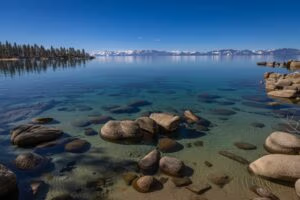
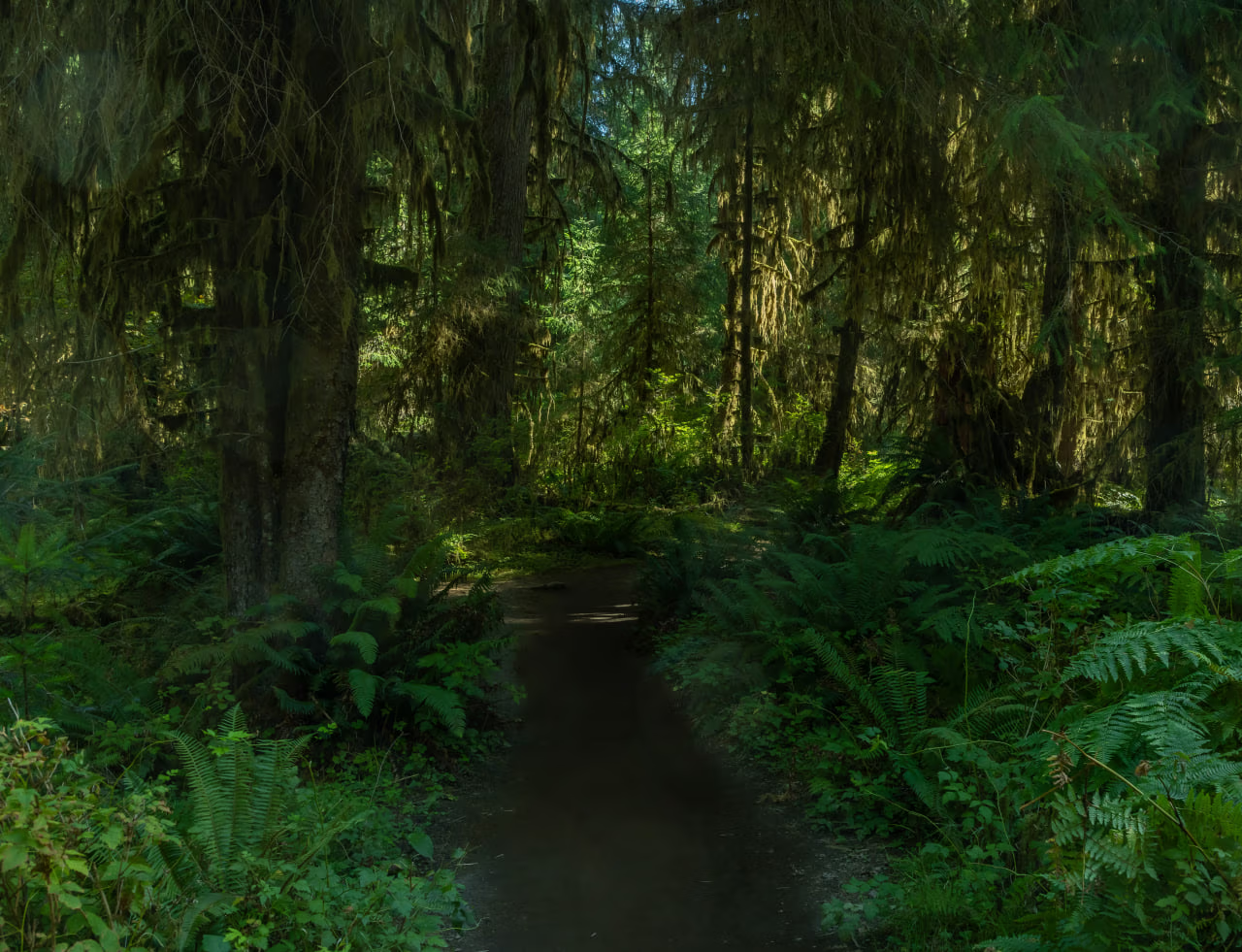
Some landscapes give us a feeling of freedom because we can see far into the distance.
Others create a sense of peace because we cannot.
A forest belongs to the second kind.
There may be no visible horizon.
No distant mountain.
No open sky stretching across the composition.
Instead, there are trunks, branches, shadows, layers of vegetation and small passages of light.
The landscape does not invite the eye to escape.
It invites the eye to remain.
This is one of the qualities I find most compelling about photographing forests.
A forest creates presence not through openness, but through enclosure.
And that enclosure has an architecture of its own.
The Forest Is a Space, Not Just a Collection of Trees
When we think about a forest, we often think first about its individual elements.
Trees.
Leaves.
Moss.
Ferns.
Branches.
But the feeling of a forest rarely comes from any one of those elements alone.
It comes from their relationships.
The distance between trunks.
The height of the canopy.
The way branches overlap.
The openings that allow light to reach the ground.
The narrow spaces through which we can see deeper into the landscape.
Together, these elements form something that resembles architecture.
There are vertical structures.
There are boundaries.
There are passages.
There are ceilings made of foliage and openings that behave almost like windows.
The forest is not organized according to a human floor plan.
Yet it can create the unmistakable feeling of being inside a space.
And that feeling changes how we experience the landscape.
Shelter Without Walls
An open landscape makes us aware of distance.
A forest makes us aware of our immediate surroundings.
The trees reduce the visible world.
The canopy changes the light.
The vegetation creates boundaries without completely closing the space.
This produces an interesting relationship between enclosure and comfort.
We can feel surrounded without feeling trapped.
Protected without being separated from nature.
The difference often lies in how much visual depth remains available.
A dense wall of vegetation may feel impenetrable.
But a forest with visible layers, small openings and pathways allows the eye to move gradually through the scene.
The viewer experiences shelter while still sensing that the landscape continues.
The strongest feeling of refuge often comes from a balance between enclosure and possibility.
There is enough structure to feel held.
And enough depth to know the world continues beyond it.
Rhythm Is the Forest’s Hidden Structure
One of the most interesting visual qualities of a forest is repetition.
Tree trunks create vertical rhythms.
Branches introduce variation.
Light and shadow establish intervals.
Ferns and smaller plants repeat patterns at a different scale.
These patterns are rarely perfectly regular.
One tree may lean.
Another may disappear behind a larger trunk.
A gap may interrupt the sequence.
A patch of light may shift the visual emphasis.
This irregularity is important.
A forest can feel organized without appearing manufactured.
It contains repetition, but not mechanical repetition.
For a photographer, that creates both opportunity and difficulty.
Too many competing trunks can make a composition feel chaotic.
Too much simplification can remove the character of the place.
I look for moments when the elements begin to relate to one another.
When the verticals establish a rhythm.
When the foreground does not compete with the background.
When an opening provides a visual direction.
And when the whole scene feels coherent without becoming overly controlled.
The forest has its own order.
The photograph needs to reveal enough of that order for the viewer to feel it.
Light Gives the Forest Its Rooms
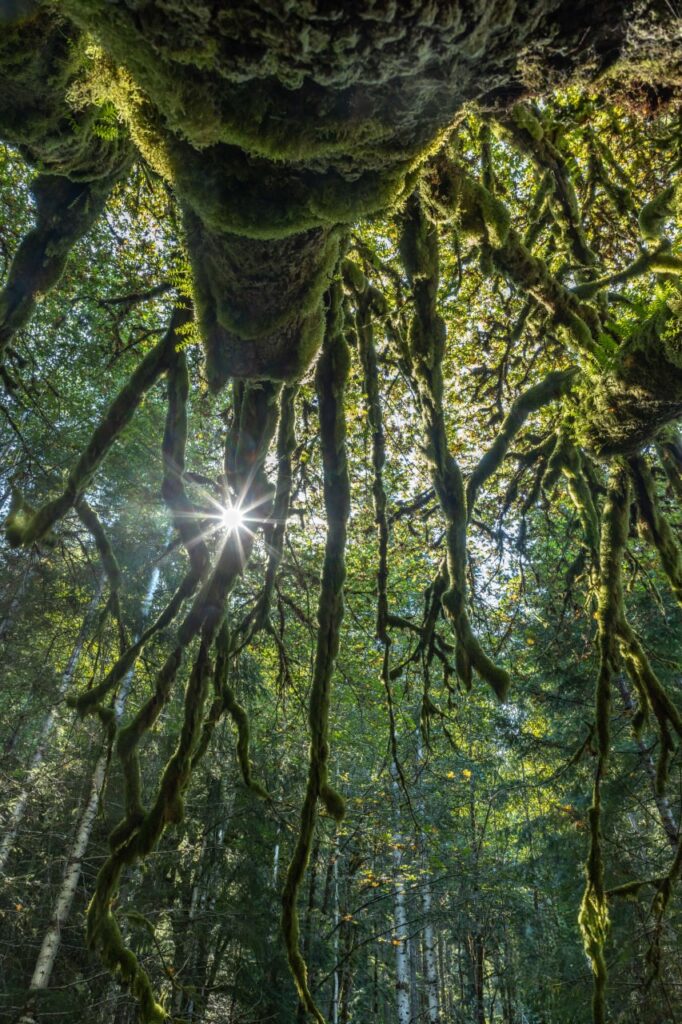
Light can completely transform the perceived structure of a forest.
On an overcast day, illumination often arrives softly from above.
The shadows become less dominant.
Colors feel quieter.
Details within the vegetation become easier to distinguish.
The forest may feel continuous, as though one space flows gently into another.
Direct sunlight creates a different experience.
A shaft of light may illuminate one tree while leaving the surrounding forest dark.
An opening in the canopy may become a focal point.
A small area of moss may suddenly appear more important than the enormous trunks around it.
Light creates hierarchy.
It tells the eye where to begin.
It separates one part of the landscape from another.
And sometimes it creates the impression of a room within a room.
An illuminated clearing feels different from a shaded passage.
A bright opening beyond dark foreground trees can feel like an invitation.
A soft glow filtering through mist may give the forest a sense of depth that is difficult to see in clear, direct light.
In the forest, light does more than reveal what is there. It changes the space we feel we are entering.
The Beauty of Partial Visibility
In a mountain landscape, the distant summit may be the destination.
In a forest, the destination is often less obvious.
We see only part of what lies ahead.
A trunk hides another.
Branches overlap.
The ground disappears behind vegetation.
Light suggests an opening that may be only a few steps away.
This partial visibility creates curiosity.
The photograph does not explain everything at once.
It allows the viewer to discover the scene gradually.
That is one reason forest photographs can hold attention without relying on dramatic subjects.
The eye moves from one layer to another.
A detail becomes visible.
A small opening begins to matter.
The background reveals something that was not immediately apparent.
The image rewards a slower kind of looking.
There is no need to understand the entire landscape in the first second.
Some of it can remain hidden.
When Complexity Becomes Calm
Forests are visually complex.
There may be thousands of leaves, branches, textures and overlapping shapes within a single composition.
Yet some forest photographs feel remarkably peaceful.
Why?
For me, the answer is not simply that the subject is natural.
A photograph of nature can be just as visually demanding as a photograph of a crowded city.
The difference is how the elements are organized.
When everything competes equally for attention, the image becomes restless.
When the composition establishes rhythm, depth and hierarchy, complexity becomes easier to experience.
One tree may anchor the scene.
A passage of light may guide the eye.
The background may gradually soften.
The smaller details remain available without insisting on immediate attention.
That balance is particularly important in my forest photography.
I do not want to remove the richness of the landscape.
I want to find the point where its richness begins to feel ordered.
Calm does not always require simplicity. Sometimes it requires harmony within complexity.
The Forest Changes Our Sense of Scale
Mountains often communicate scale through comparison.
We see a distant peak and recognize its enormous size.
Forests communicate scale differently.
A large tree can extend beyond the upper edge of the photograph.
Its trunk may dominate the foreground.
The canopy may disappear from view.
We understand that the subject continues beyond what we can see.
The photograph becomes a fragment of something much larger.
This changes the viewer’s relationship with the image.
Instead of standing outside the landscape and observing its full extent, we may feel positioned within it.
The trees surround the viewpoint.
The foreground feels close.
The background remains layered and partially concealed.
That creates a more intimate form of scale.
We do not need to see the entire forest to understand its presence.
Sometimes a few trunks and the space between them are enough.
Why Forests Feel Different in Photographs
Standing inside a forest is a physical experience.
We hear movement in the canopy.
We notice temperature and moisture.
We feel the softness of the ground.
We become aware of the distance between trees and the changing quality of the air.
A photograph cannot reproduce those sensations directly.
It has only visual information.
But photography can preserve something of the spatial experience.
A low viewpoint may emphasize the height of the trees.
A narrow opening may suggest a passage.
Soft atmospheric light may communicate moisture and depth.
A carefully arranged foreground can make the viewer feel close to the landscape.
The challenge is not simply to photograph what the forest contains.
It is to communicate something about what being there feels like.
This is where composition becomes more than a technical decision.
It becomes an emotional one.
What a Forest Can Bring Into an Interior
When a forest photograph moves from the landscape onto a wall, its natural architecture becomes part of another architecture.
The relationship is especially interesting because interiors also depend on enclosure, rhythm and proportion.
Walls establish boundaries.
Windows create openings.
Columns and furniture introduce repetition.
Lighting establishes hierarchy.
A forest photograph can enter that environment with its own visual structure.
Vertical trunks may reinforce the height of a room.
Soft foliage can introduce organic complexity into a minimalist interior.
Layered woodland can create the impression of depth where the physical wall offers none.
And the sense of shelter found in certain forest compositions may help support a quieter, more intimate atmosphere.
This does not mean every forest photograph belongs in every restorative space.
A dark, densely layered forest may feel mysterious or dramatic.
A softly illuminated woodland may feel welcoming.
An open grove may communicate gentle spaciousness.
A mist-filled forest may feel contemplative and still.
The emotional quality depends on the photograph, not simply on the subject.
The question is not whether the image contains trees. It is what kind of presence those trees create.
Openness and Refuge Are Two Different Gifts
In my earlier article, Why Some Landscapes Make Us Feel More Spacious, I explored how horizons, water and distance can create psychological room.
The forest offers an important contrast.
An open landscape allows the eye to travel outward.
A forest encourages it to move inward.
One creates release.
The other creates shelter.
One gives us a sense of possibility beyond our immediate surroundings.
The other brings attention back to the space we occupy.
Neither quality is universally more calming.
They simply support different experiences.
There are moments when we want to look beyond everything around us.
And there are moments when we want to feel comfortably contained.
Landscape photography can communicate both.
This is one reason I resist thinking about nature imagery as a single visual category.
Nature does not speak with one emotional voice.
It has many.
Photographing the Spaces Between
The longer I study forests photographically, the more interested I become in what exists between the obvious subjects.
Not only the trees.
But the space between the trees.
Not only the light.
But the darkness that gives the light its meaning.
Not only the visible path.
But the surrounding vegetation that makes it feel like a passage.
These relationships often determine whether a forest photograph feels crowded, mysterious, welcoming or quiet.
A forest may contain countless individual details.
But a photograph becomes meaningful when those details begin to form one experience.
That is what I am looking for.
Not a perfect tree.
Not the most dramatic beam of light.
Not the densest or oldest woodland.
But a moment when the landscape seems to have found its own balance.
The Quiet Architecture of Presence
A forest does not need a visible horizon to create depth.
It does not need an open sky to create space.
And it does not need emptiness to create calm.
Its architecture comes from relationships.
Trunks and openings.
Shelter and distance.
Shadow and illumination.
Repetition and variation.
What interests me most is how these ordinary elements can create such a distinct emotional experience.
Inside a forest, the world can feel smaller.
But that smaller world can also feel more complete.
The attention no longer needs to travel toward something distant.
It can settle into what is already here.
A forest does not give us more room by opening the world. It gives us peace by making the space around us feel enough.