
Forest light photography often begins with something almost invisible.
Not a spectacular landscape.
Not a dramatic mountain.
Not a view stretching toward the horizon.
Sometimes it begins with a small opening between trees.
A point of light.
A brief moment when sunlight reaches into a forest that has remained in shadow.
And suddenly, the entire scene feels different.
In the photograph at the center of this story, sunlight appears between the trunks of a dense forest, forming a small, radiant star.
Around it, the woodland remains quiet.
Moss-covered branches cross the composition.
Tall trees establish a natural rhythm.
The forest floor is filled with layers of green vegetation.
Nothing in the landscape appears arranged for the camera.
Yet, for that moment, the elements come together with a remarkable sense of order.
The light does not change what the forest is. It changes what we are able to see.
That distinction is what makes this kind of photography so meaningful to me.
The Forest Before the Light
A forest is one of the most visually complex environments to photograph.
There are countless shapes competing for attention.
Trees overlap.
Branches cross one another.
Leaves and ferns create layers of texture.
Bright openings in the canopy contrast with deep shadows beneath the trees.
The eye moves from one detail to another, sometimes without finding a clear place to settle.
This complexity is part of the forest’s beauty.
But it also presents a photographic challenge.
How do you create a coherent image from a landscape containing so much information?
For me, the answer often begins with observation.
Before thinking about the photograph, I look for relationships.
The distance between trunks.
The way branches frame an opening.
The repetition of vertical forms.
The subtle separation between foreground and background.
And, above all, the direction of the light.
Without a clear visual relationship, a forest photograph may become an accumulation of beautiful details.
With that relationship, those details can begin to form a single experience.
When Light Becomes the Subject
Light is essential to every photograph.
But sometimes it becomes something more than illumination.
It becomes the subject itself.
In this forest image, sunlight appears through a narrow opening between the trees.
The surrounding trunks remain largely in shadow.
The moss-covered branches are visible, but they do not compete with the brightest point.
The eye is naturally drawn toward the small burst of light.
Then it begins to explore the forest around it.
This creates an interesting reversal.
The forest is physically immense.
The sunlight occupies only a small portion of the frame.
Yet that small point of brightness becomes the emotional center of the photograph.
It gives the surrounding darkness meaning.
It establishes direction.
And it creates a sense of depth that might otherwise be difficult to communicate.
Sometimes the smallest element in a landscape carries the greatest visual significance.
The Importance of What Remains in Shadow
When photographing sunlight in a forest, it can be tempting to brighten everything around it.
To reveal every branch.
Every trunk.
Every layer of vegetation.
But darkness has an important role in the composition.
Without the shadowed forest, the light would lose much of its presence.
The contrast between illumination and darkness gives the image its structure.
The viewer recognizes that the light is reaching into a place where it has not yet arrived everywhere.
Some details become visible.
Others remain concealed.
This partial visibility creates mystery.
It allows the image to suggest more than it explains.
I find that especially compelling in woodland photography.
The forest does not need to reveal itself completely.
Its beauty can remain partly hidden.
And that hidden quality encourages a slower kind of looking.
The viewer begins with the light.
Then notices the surrounding trunks.
Then the branches.
Then the soft layers of vegetation deeper within the scene.
The photograph continues to open through attention.
Waiting for the Relationship to Become Clear
Photographing a forest requires a different kind of patience from photographing an open landscape.
In a mountain scene, the direction of the sun may be relatively easy to anticipate.
The horizon is visible.
The major forms are clear.
The relationship between light and subject can often be understood from a distance.
A forest is more complicated.
The canopy interrupts the light.
Branches create small openings.
A bright area can disappear as the angle of illumination changes.
Even a slight adjustment in camera position can alter which parts of the scene are visible.
A point of sunlight may appear between two trunks from one position and vanish when the camera moves a short distance.
This makes careful observation important.
Rather than assuming that the most dramatic viewpoint will produce the strongest photograph, I look for the position where the relationships become coherent.
Where the light belongs naturally within the composition.
Where the trunks provide structure.
Where the surrounding vegetation supports the scene rather than distracts from it.
Patience in photography is not always about waiting for better conditions.
Sometimes it is about looking carefully enough to recognize the conditions already present.
The Star of Light
One of the most distinctive elements in this photograph is the star-shaped sunlight appearing between the trees.
In photography, this effect is commonly called a sunstar.
It occurs when a bright point of light passes through a relatively small lens aperture, producing visible rays through diffraction around the aperture blades.
The shape and number of rays depend partly on the lens and aperture design.
But the technical explanation is only one part of the experience.
What interests me is the visual relationship.
The starburst is small compared with the surrounding forest.
Yet it becomes the image’s natural focal point.
Its radiating lines contrast with the vertical tree trunks and irregular shapes of the branches.
The geometric quality of the light creates a moment of clarity within an otherwise organic composition.
It feels almost like a quiet center.
Not because the forest becomes less complex.
But because the viewer now has a place from which to understand it.
The Forest Has Its Own Architecture
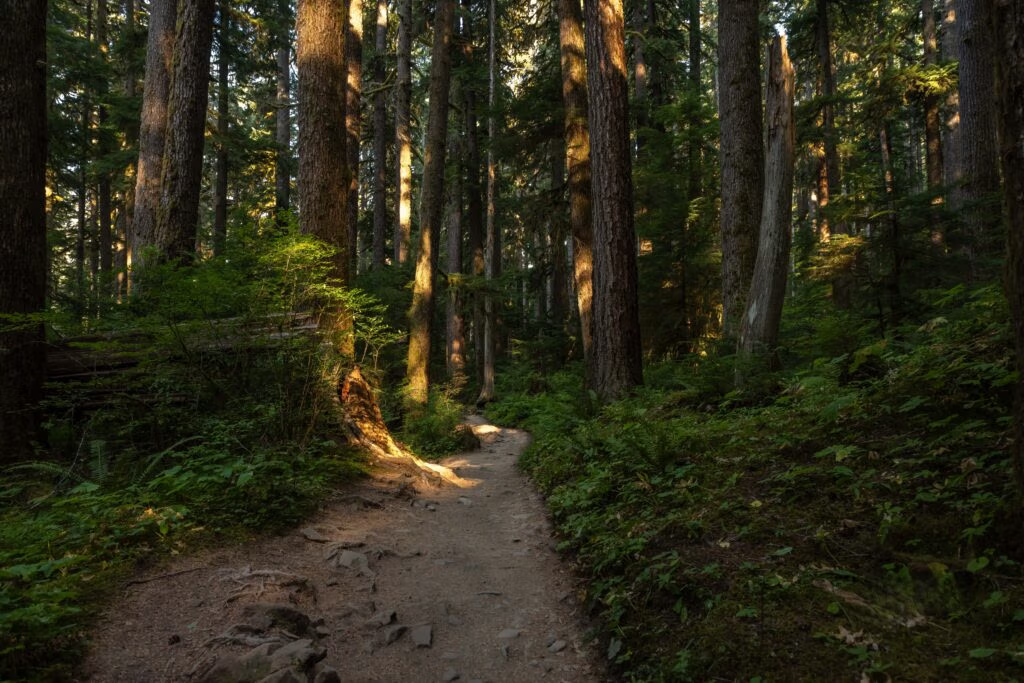
In my earlier essay, The Quiet Architecture of a Forest, I explored how trees, branches and natural openings create a sense of shelter and enclosure.
That idea is present in this photograph as well.
The trunks establish vertical structure.
Branches form overhead boundaries.
The vegetation creates visual layers.
And the opening that allows sunlight to pass through behaves almost like a window.
The forest becomes a space within a space.
It is not designed by human hands.
Yet its proportions, repetition and natural relationships can feel remarkably harmonious.
That harmony is not the same as perfect symmetry.
The trunks are not evenly spaced.
The branches do not follow identical patterns.
The undergrowth grows in different directions.
And still, the landscape can feel complete.
There is a beautiful kind of order in this irregularity.
For a photographer, the challenge is not to impose artificial perfection upon it.
It is to recognize the relationships that already exist.
A Different Kind of Landscape Photography
Landscape photography is often associated with extraordinary viewpoints.
High mountains.
Grand waterfalls.
Enormous canyons.
Dramatic coastlines.
And those places certainly deserve attention.
But some of the most meaningful photographs do not depend on physical grandeur.
They depend on perception.
A small beam of light may become more compelling than an entire mountain range.
A single moss-covered branch may communicate the character of a forest more intimately than a wide panorama.
A quiet pathway may invite the viewer into a place more effectively than a dramatic overlook.
This is one reason I continue to value forest photography.
It reminds me that scale and significance are not the same thing.
A photograph does not need an immense subject to carry a meaningful experience.
Sometimes it needs only an ordinary place seen with greater attention.
While open horizons offer a sense of distance, as explored in Why Some Landscapes Make Us Feel More Spacious, the forest invites us to discover beauty through closeness, shelter and attention.
The Difference Between Finding and Forcing an Image
There is always a temptation in photography to search for something more impressive.
Stronger light.
More dramatic color.
A clearer subject.
A more recognizable composition.
But nature does not exist to satisfy our expectations.
The light may never become more dramatic.
The forest may never offer a perfect opening.
The conditions may remain subtle.
And the strongest image may be the one that requires us to appreciate what is already there.
I think this distinction matters.
There is a difference between finding an image and forcing a landscape to become the image we imagined.
Finding begins with observation.
It allows the place to reveal its character.
It accepts that the photograph may be quieter than expected.
Forcing begins with a predetermined result.
It risks overlooking the smaller relationships that make the scene distinctive.
When I look at the sunlight in this forest photograph, I am reminded of the value of the first approach.
The image does not need to turn the forest into a spectacle.
The small point of light is enough.
Why the Light Feels Different in a Forest
Sunlight on an open lake can make the entire landscape luminous.
Sunlight across a desert can reveal the structure of enormous formations.
But in a forest, light is often experienced in fragments.
A bright opening.
A narrow beam.
An illuminated leaf.
A small area of moss.
A tree trunk touched by warmth while everything around it remains cool.
These fragments create intimacy.
The viewer does not need to understand the entire landscape at once.
Attention can settle on a single relationship.
Light and shadow.
Texture and atmosphere.
A small opening within a much larger environment.
This is one of the reasons I find forest light so emotionally distinctive.
It can feel both delicate and powerful.
A narrow passage of sunlight does not physically alter the trees.
Yet it can transform how the whole forest is perceived.
The scene becomes more legible.
More dimensional.
More alive.
Photographing What Cannot Be Repeated Exactly
A photograph preserves a particular relationship between light, place and time.
The trees may remain in the same positions.
The pathway may remain.
The moss may continue growing over the branches.
But the light will not return in precisely the same way.
The angle changes with the hour and season.
Clouds influence its intensity.
The atmosphere changes its quality.
Even the photographer’s position affects how the light appears through the trees.
This makes the moment valuable.
Not because it is necessarily rare in an absolute sense.
But because the exact relationship cannot be possessed or reproduced at will.
Photography allows us to preserve one interpretation of that moment.
A small encounter between light and landscape becomes something we can return to.
The photograph holds it still.
But what it preserves is the memory of a world that never stops changing.
From the Forest to an Interior
A photograph like this can take on another life when it moves into an interior.
The physical forest is gone.
There are no towering trees overhead.
No uneven ground.
No shifting light passing through the canopy.
But the visual relationships remain.
The vertical trunks create structure.
The moss-covered branches introduce organic texture.
The deep greens communicate enclosure.
And the small point of sunlight becomes a visual destination.
In a residential room, such an image might create a feeling of refuge and contemplation.
In a hospitality setting, it could introduce warmth and natural depth without depending on a brightly colored composition.
In a quiet workspace or private retreat, it might offer a moment of visual distance from the surrounding architecture.
Its presence would depend on the scale, finish, lighting and room itself.
But the photograph carries something important from its original setting.
A sense that beauty can emerge from a small relationship within a much larger world.
That is one of the qualities I hope my landscape photography can bring into the spaces people inhabit.
Not simply another view.
But another opportunity to notice.
My Forest collection explores these quiet relationships between trees, light and atmosphere, preserving moments when the natural world reveals its beauty through the smallest details.
What the Photograph Reminds Me Of
There is something humbling about light.
We depend on it to see the world.
Yet we do not create the light that reaches the landscape.
Nor do we create the trees, the intricate structure of their branches, or the remarkable relationships through which light becomes visible.
Photography allows us to witness these relationships.
To recognize them.
To preserve a small part of their beauty.
But the moment exists before the photograph.
And its significance does not depend on whether a camera is present.
That thought has become increasingly important to the way I understand my work.
I do not want every photograph to announce itself through intensity.
I want some images to invite quiet attention.
To reveal something beautiful that could easily have been passed without notice.
To remind us that even familiar places contain more than we can fully understand at first glance.
Sometimes the gift is not a spectacular view.
It is being present enough to recognize a moment of grace within the ordinary.
When the Forest Reveals Itself
The forest in this photograph is not transformed into another place.
It remains what it has always been.
Trees.
Moss.
Branches.
Vegetation.
Depth.
Shadow.
And light passing through a small opening.
Nothing essential has been added.
Yet the photograph offers a particular way of seeing.
The sunlight provides a point of attention.
The surrounding darkness gives it meaning.
The trees establish rhythm.
The vegetation creates continuity.
Together, they form an image that feels quietly complete.
For me, this is what makes photographing the natural world so rewarding.
There are moments when an apparently ordinary landscape reveals an extraordinary relationship.
The camera does not create that beauty.
It only gives me an opportunity to preserve and share what I have been fortunate enough to see.
The most beautiful light does not always illuminate the entire landscape. Sometimes it reveals just enough to remind us how much beauty was already there.